
Stripe Rate Limits and Burst Handling in High-Volume Integrations
Understanding Stripe's layered rate limits prevents costly retry storms in production.
Stripe's rate limits are not a single ceiling but a layered system, and high-volume integrations fail when they treat the layers as one. The limits that matter for scaling teams sit at the global level, the per-endpoint level, and inside a set of load-shedding mechanisms that most documentation barely mentions, and each one produces a different failure signature that calls for a different fix.
How Stripe's rate-limit architecture works
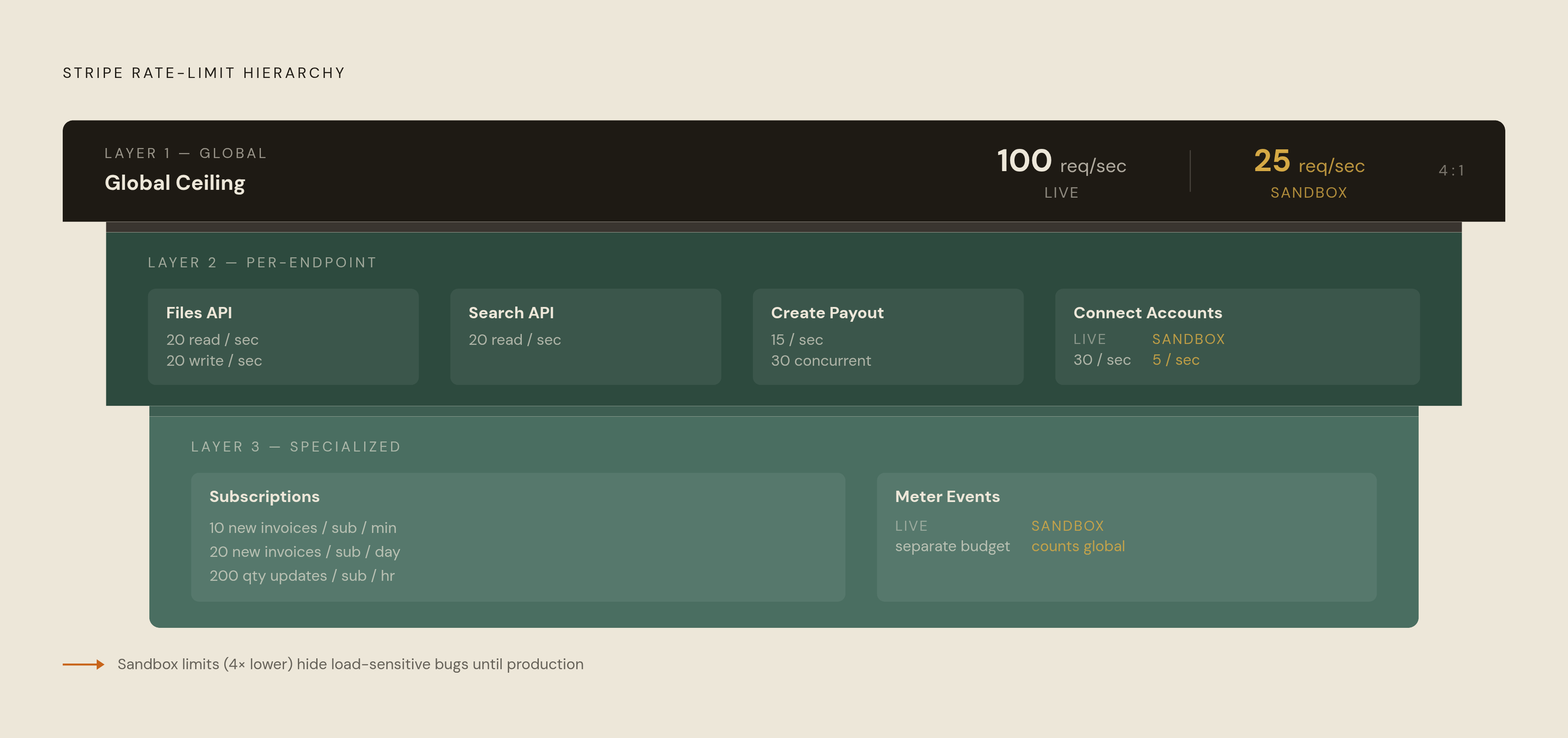
Stripe's support documentation sets the global ceiling at 100 parallel requests per second in live mode and 25 per second in sandbox, the environment formerly called test mode. That four-to-one gap between live and sandbox throughput is not a rounding difference: it changes which bugs an integration can even encounter before launch.
Below that global ceiling, a set of per-endpoint sub-limits apply independently, and an integration can exhaust one of these without coming close to the global cap. The Files API permits 20 read and 20 write operations per second. The Search API allows 20 read operations per second. The Create Payout API caps requests at 15 per second with 30 concurrent. Meter Events, which power Billing usage tracking, run on a separate and much higher per-second budget in live mode; in sandbox they fall back to counting against the global limit, and on connected accounts they count toward the standard 100-per-second budget. Subscriptions carry their own throttles too: 10 new invoices per subscription per minute, 20 per day, and 200 quantity updates per subscription per hour. If you're creating Connect accounts, you get 30 per second in live mode but only 5 per second in sandbox.
All of these budgets attach to the account, not the API key. Concurrent workers sharing one Stripe account draw from the same pool, so adding more workers without coordinating their request rates does not relieve pressure on the budget: it accelerates the exhaustion of it. A team that scales horizontally assuming each new worker gets its own allotment will find the opposite is true.
A separate failure mode deserves its own category: lock-timeout 429s. These carry no Stripe-Rate-Limited-Reason header, and they happen when another request or internal Stripe process is already holding the object being modified, not because throughput has exceeded any budget. Serializing writes to that object resolves this. Backing off and retrying does not help, because the request never faced a throughput problem to begin with.
The algorithm underlying the per-second caps is a token bucket, which tolerates short bursts above the nominal rate, useful during a flash sale or a sudden spike in checkout traffic, while still holding the account to a steady average over time. Layered on top of the per-second cap sits a concurrent-requests limiter, plus two load shedders: one tracking fleet-wide usage, another tracking worker utilization. The load shedders exist to keep Stripe's critical infrastructure available when the system is under heavy strain, and when they activate, they shed non-critical requests first, starting with test mode traffic. That detail, combined with the fourfold gap between sandbox and live throughput, means the environment most teams use to validate their rate-limit handling is also the environment Stripe is most willing to sacrifice under load.
The failure modes high-volume integrations hit in practice
Each layer of this stack produces its own failure signature, and the single biggest driver of retry storms and throttling incidents is treating every 429 as the same problem.
Bulk-operation bursts are the most common entry point. Importing a large customer list or running mass refunds in a tight loop draws down the global 100-per-second budget quickly enough to starve live, time-sensitive charges running on the same account. Stripe's own guidance addresses this directly: limit background jobs to a subset of the maximum so live charges can still succeed during periods of heavy batch activity.
Webhook fanout causes a quieter but equally damaging version of the same problem. A single inbound webhook can trigger a cascade of synchronous API calls, and every one of those calls counts against the same per-account budget, so this pattern tends to exhaust the concurrent-requests limiter well before the per-second ceiling comes into view. The failure appears as sporadic 429s tied to specific webhook events rather than to overall traffic volume, which is harder to diagnose from aggregate metrics alone.
Sandbox overuse cuts in two directions. Code validated only against the 25-per-second sandbox cap can look stable in testing while lacking the back-pressure handling it will need once it meets the 100-per-second live budget. The reverse also happens: retry patterns that would surface clearly against the tighter sandbox limit stay hidden inside a live budget with four times the headroom, so a team testing exclusively in production-adjacent conditions can miss the same class of bug from the other side.
Agentic AI workloads introduce a newer version of this problem. Bursty inference traffic that generates usage events can hit the 1,000-events-per-second Meter Events cap on an ordinary day, well before any human would call the volume unusual, and the resulting 429s read like a billing outage when the actual cause is metering throughput. A related blind spot sits in the v2 Meter Event Stream API: it handles much higher volumes using short-lived session tokens, but it works only in live mode. No sandbox equivalent exists for that specific code path, so teams validating high-throughput metering logic have nowhere to run it except against live credentials.
Retry storms compound every one of these conditions when backoff isn't staggered. If multiple instances of an integration receive a 429 at the same moment and retry on identical schedules, they converge on the API in synchronized waves, and the resulting storm can run longer than the burst that triggered it.
Stripe does expose a Stripe-Rate-Limited-Reason header that identifies which layer fired, global-rate, global-concurrency, endpoint-rate, endpoint-concurrency, or resource-specific, so a 429 doesn't have to be a mystery once it arrives. What Stripe does not expose is any X-RateLimit-Remaining or Retry-After header. There's no pre-emptive counter telling an integration how much budget remains before it spends it. Engineers often assume their SDK's built-in retry logic handles all of this automatically. It handles the retry. It does not tell an integration when to stop sending requests before the ceiling is reached, and that gap between automatic retrying and proactive throttling is where most of the failure modes above actually originate.
Specific mitigation strategies matched to each failure mode
Every failure mode above has a known fix, and the fixes are not interchangeable: applying backoff logic to a lock-timeout 429, for instance, does nothing but waste a retry cycle.
For bulk-operation bursts, the fix matches Stripe's own guidance precisely: cap background jobs at a fraction of the maximum throughput and let time-sensitive live charges take priority. This means throttling background workers explicitly at the application layer rather than waiting for 429 responses to do the throttling after the fact.
For webhook fanout, the fix is architectural. Inbound webhooks should be queued and processed asynchronously rather than triggering synchronous API calls directly inside the webhook handler. That decouples the rate at which webhooks arrive from the rate at which downstream API calls go out, so a burst of incoming events doesn't translate one-to-one into a burst of outgoing requests.
For high-volume metering, the prescribed approach is pre-aggregation. Usage should accumulate inside the application, in Redis or an equivalent store, and get flushed to Stripe as a single aggregated event on a schedule. This keeps the integration well under the Meter Events cap and reduces the raw volume of API calls an integration makes over time.
For the missing remaining-budget header, the fix is to stop reacting to errors and start preventing them. A client-side token bucket, sized comfortably below Stripe's actual limit, keeps an integration from ever approaching the ceiling rather than waiting for a 429 to signal that it already has.
Every write, regardless of which of these mitigations applies, needs an idempotency key. Safe retries depend on Stripe recognizing a duplicate request and returning the original result. A missing idempotency key turns an otherwise harmless retry into a double-charge risk, which is a considerably worse outcome than the throttling it was meant to resolve.
For lock-timeout 429s, the fix is unrelated to rate limits. These responses carry no Stripe-Rate-Limited-Reason header, because they aren't throughput events but contention events, caused by another request or process already holding the object in question. Serializing writes to that object resolves the problem; backoff and retry logic will not, no matter how well-tuned.
That leaves one failure mode without a clean operational fix: the v2 Meter Event Stream API works only in live mode, and no sandbox equivalent exists for it. Teams building high-throughput metering integrations have no way to exercise that code path without touching live credentials, so the standard test-before-you-ship workflow breaks down precisely where the stakes, metering accuracy tied directly to billing, are highest. That gap is a testing problem, not a mitigation problem, and it's where the rest of this piece turns.
Stripe's sandbox as an unreliable proxy for production rate-limit behavior
Stripe's sandbox reproduces the shape of rate-limit responses, the 429 status code, the general structure of an error. It does not reproduce the scale or the completeness of production behavior, so a team can pass every sandbox test and still ship an integration that fails under live conditions.
The sandbox's 25-per-second cap is a quarter of the live 100-per-second ceiling, so code can clear sandbox testing while still lacking adequate back-pressure handling for production scale. It also means the reverse: code that trips over the stricter sandbox limit may never come close to tripping the more generous live limit, producing a false negative that sends engineers chasing a problem that doesn't exist at the scale they'll actually run at.
The v2 Meter Event Stream API compounds this. Because it operates in live mode only, there is no way to exercise that code path in sandbox. Teams building against it end up validating a structural blind spot rather than a known limitation, because no amount of sandbox testing closes the gap.
Sandbox transactions also don't touch real card networks, so you can never confirm decline codes and network-specific retry behavior through sandbox testing, no matter how accurately it models rate limits.
Because Stripe's rate limits apply per account rather than per API key, if you test inside a shared sandbox account, your test traffic mixes with another engineer's burst scenario, and reproducing a specific burst pattern reliably becomes close to impossible. The test environment introduces its own shared-state interference, the same category of problem the rate limits themselves are meant to prevent in production.
Sandbox testing also requires live credentials and an active network connection, which rules it out for air-gapped CI environments and ties every test run to Stripe's own sandbox availability and latency. And fault injection, triggering 429s at a controlled rate, forcing lock-timeout 429s, simulating 503s or injected latency, cannot be done on demand inside Stripe's sandbox. Engineers can observe these conditions when they happen to occur naturally. They cannot reproduce them systematically. The conditions that cause the worst production incidents are exactly the ones sandbox testing is least equipped to validate.
What a stateful, verified Stripe simulator makes testable
A locally hosted, stateful simulator closes most of the gaps described above, because it turns rate-limit conditions, sequential state, and fault injection into things an engineer can program directly.
Rystic is a stateful Stripe simulator built to run locally or inside a CI pipeline, and it's the fullest implementation of this approach currently available. Its statefulness is the core property: each API call updates the simulator's internal world, so creating a PaymentIntent, updating it, and canceling it leaves a trace that a subsequent GET request reflects accurately, including the cancellation. The per-resource hourly update cap tracks across the full session rather than resetting with each call, matching how Stripe itself enforces that limit.
Rystic is continuously verified against the live Stripe API before every release, which keeps the simulator's behavior aligned with Stripe's actual API surface as that surface changes over time. Fault injection is treated as a core feature rather than an add-on: engineers can trigger 429s at a specified rate, inject lock-timeout 429s to test serialization logic that ordinary backoff can't fix, and simulate 503s and latency spikes, all repeatably within the same test run. None of this needs live credentials or network access, and none of it consumes rate-limit budget against a real Stripe account, so CI pipelines can run entirely offline without depending on Stripe's own sandbox uptime.
The statefulness matters most for the failure modes already described. Testing for retry storms requires a simulator that counts requests across a burst window and returns 429s in proportion to that count, something a stateless mock cannot do, since a hardcoded 429 on a fixed path can't reproduce the gradual depletion pattern of a token bucket. Testing idempotency logic requires the simulator to recognize a repeated idempotency key and return the original response instead of processing the request again, which depends entirely on the simulator remembering the first request. If you test webhook fanout, you need the simulator to emit webhook events as actual state changes, so you can verify that the resulting downstream API calls stay inside budget, with state carried across two linked call sequences.
Rystic also closes the v2 metering blind spot that Stripe's own sandbox leaves open. Because the simulator runs locally and is fully configurable, you can exercise the high-throughput Meter Event Stream code path inside CI without live-mode credentials, and you need a Stripe sales arrangement only once your volumes exceed 10,000 events per second.
Other approaches to simulation and service virtualization exist, built around stateless recorded-cassette replay or hand-maintained stubs. Their shared limitation is structural: they don't update automatically as Stripe's API changes, and they can't track cumulative state across a sequence of requests. Drift between the mock and the real API is discovered in production rather than caught in CI, which defeats the purpose of testing against a simulator.
Building a CI pipeline that can reproduce Stripe rate-limit conditions on demand
A simulator only improves on sandbox testing if it's wired into CI in a way that actually makes rate-limit conditions reproducible, isolated, and fast. Swapping an endpoint URL from Stripe's sandbox to a local simulator is a necessary first step, but it isn't sufficient on its own.
Test isolation has to come first. Because Stripe's own rate limits apply per account rather than per key, tests that share a single simulator instance run into the same interference problem that plagues shared sandbox accounts: one test's burst scenario pollutes another's budget counter. Each test run needs its own isolated simulator instance with a clean budget from the start, so a burst test for webhook fanout doesn't inherit leftover consumption from an idempotency test that ran moments earlier.
From there, the pipeline can build outward: fault injection configured per test case, so a retry-storm test specifies its own 429 rate and burst window instead of relying on whatever condition the simulator happens to produce by default. Lock-timeout scenarios get injected directly, rather than waited for, so the serialization logic described earlier can be verified on every single run instead of on the occasions a real contention event happens to occur in staging. High-throughput metering tests exercise the v2 code path locally, so they close the blind spot that live-mode-only sandbox testing leaves open.
None of this replaces the judgment required to match each failure mode to its correct fix. It does mean that judgment can be tested before deployment rather than validated for the first time against a production incident, which is the entire argument for building rate-limit testing around a stateful, verified simulator instead of treating Stripe's sandbox as a stand-in for production it was never built to be.

